
- admin
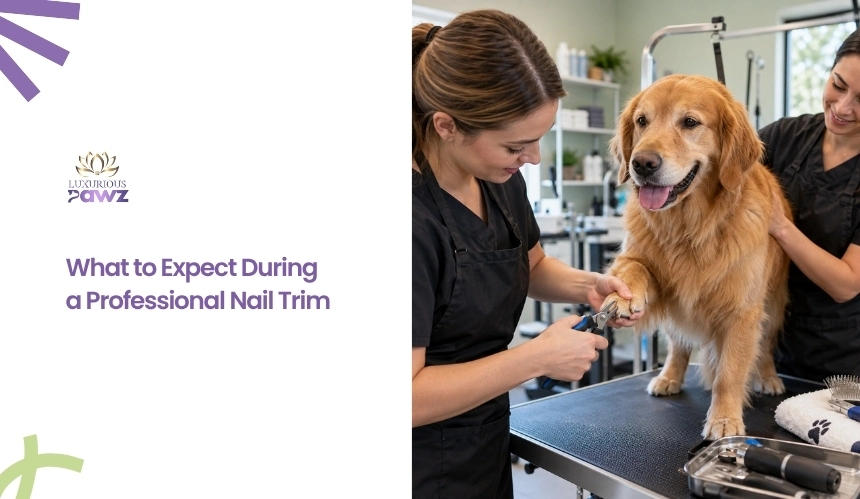
What to Expect During a Professional Nail Trim
A professional nail trim is more than simply shortening the visible portion of a pet’s nails. The groomer must assess nail structure, identify the quick, control paw movement, and adjust handling to the animal’s tolerance.
For pets in Altadena, where outdoor activity and varied walking surfaces can affect natural nail wear, the right maintenance interval can differ from one pet to another. Understanding the process helps owners recognize what safe, competent nail care should look like.
What Happens Before the Nail Trim Begins?
Before any cutting or grinding starts, a professional groomer evaluates the condition of each nail and determines how much length can be safely removed without reaching the quick. The assessment considers nail thickness, curvature, brittleness, splitting, previous damage, and whether the nails have become significantly overgrown.
The groomer also examines the paws for sensitivity or abnormalities that could make routine trimming uncomfortable. This initial evaluation helps determine whether clippers, a grinder, or a combination of techniques is most appropriate.
It also establishes how the pet should be positioned, how firmly the paw needs to be supported, and whether the animal can comfortably tolerate the procedure.
For pets in Altadena, individual activity levels and regular exposure to outdoor walking surfaces may also provide useful context when evaluating natural nail wear and overall nail condition.
From Kinneloa, Janes Village, La Vina, and Rubio Highlands, pets experience a mix of foothill terrain, residential streets, and outdoor environments that can affect coat condition, debris accumulation, and overall grooming needs.
Dog grooming in Altadena, CA fits naturally into these distinct local routines, particularly for dogs moving between hillside properties, tree-lined neighborhoods, and nearby open-space areas.
Paw and Nail Assessment
The groomer first examines each paw rather than assuming every nail requires the same amount of trimming. Nail length, thickness, curvature, splitting, brittleness, and signs of previous damage can influence the technique.
The location of the quick, which contains blood vessels and nerves, is particularly important. With light-colored nails, it may be visible through the nail.
Dark nails provide less visual information, so the groomer generally removes small amounts progressively and watches the exposed nail for changes that indicate proximity to the quick.
The assessment should also include dewclaws in dogs. Because these nails may not contact the ground, they receive little natural abrasion and can become disproportionately long. In severe cases, an overgrown dewclaw can curve toward the paw pad.
Do you know? A large UK primary-care veterinary study found that 5.52% of dogs were diagnosed with overgrown nails during the study period. That placed overgrown nails among the more frequently recorded individual disorders in the dataset.
Handling and Positioning
Positioning is selected according to the individual pet rather than using one rigid restraint method. The objective is to stabilize the paw while allowing the animal to remain as relaxed and cooperative as possible.
For some pets, minimal restraint while standing or sitting is sufficient. Others may tolerate a supported position better. Cats, in particular, can become more resistant when excessive restraint is introduced, so gentle positioning and gradual handling may produce a better response.
A professional also considers whether the pet has painful, damaged, or unusually sensitive nails. A grooming session should not proceed as though every nail is routine when an abnormality suggests a veterinary issue.
How Does a Professional Nail Trim Work?
Once the initial assessment is complete, the groomer works methodically through each paw, handling one nail at a time rather than removing a large amount of length at once.
The process combines controlled positioning, careful trimming or grinding, and repeated visual checks to avoid the quick and protect the surrounding paw tissue.
The amount removed depends on the nail’s current length, thickness, curvature, and visible quick, particularly when nails are dark or significantly overgrown.
For pets in Altadena, the groomer may also consider how regular outdoor activity and contact with different walking surfaces have affected natural nail wear. The objective is controlled reduction to a functional length, not simply making the nails as short as possible.
Across Altadena’s foothill communities, including Chaney Trail, Lincoln Avenue, and the areas near Eaton Canyon, pets encounter a distinctive combination of paved neighborhood routes, sloped terrain, and rugged outdoor surfaces.
This varied environment can produce uneven nail wear from one paw or nail to another, particularly for pets that move between residential streets and foothill trails.
Pet nail trimming in Altadena, CA therefore fits naturally into routine care for dogs and cats living throughout the area, helping account for differences in how each pet’s nails respond to its everyday surroundings.
Separating and Stabilizing Each Nail
The paw is supported while individual nails are isolated. This reduces accidental movement and allows the groomer to see the cutting point clearly.
For dogs, the paw may need to be positioned so that the groomer can account for both weight-bearing nails and dewclaws. For cats, gentle pressure on the paw pad can extend the claw for inspection and trimming.
The process may also be deliberately slower for pets with dark or heavily curved nails because the quick cannot always be identified visually. Small, controlled reductions provide more opportunities to inspect the nail before proceeding.
Trimming or Grinding the Nail
Professional nail care may involve clippers, a grinder, or a combination of techniques. Clippers remove a defined section quickly, while grinding can gradually reduce the nail and leave a smoother edge.
With dark nails, progressive trimming is particularly useful because removing a small amount at a time makes it easier to monitor the internal structure. Veterinary guidance recommends small cuts rather than attempting to remove a large section at once.
Grinding requires its own precautions. Excessive contact can generate heat, and a rotating grinder can catch surrounding hair. VCA guidance notes that brief grinding intervals help prevent the nail from becoming uncomfortably warm.
The goal is therefore not maximum shortening. It is a functional length that avoids the quick while reducing excessive contact, snagging, and sharp edges.
Checking Each Nail After Trimming
Each nail should be inspected before moving to the next one. The groomer checks the cut surface, overall length, edge condition, and any evidence of bleeding or irritation.
A gradual approach is especially useful when the quick has extended farther toward the nail tip because of prolonged overgrowth. Removing too much at once increases the chance of contacting sensitive tissue.
The finished nail should also be evaluated in relation to the paw. Nail length is not an isolated cosmetic measurement. In dogs, nails that contact the ground while standing can indicate that they have become too long.
How Do Groomers Handle Nervous or Resistant Pets?
A professional nail trim is also a handling exercise because the groomer must manage both the nails and the pet’s physical and behavioral response throughout the appointment. A pet that repeatedly withdraws a paw, stiffens its body, freezes, trembles, vocalizes, pants excessively, or attempts to escape may be showing that the procedure has exceeded its current tolerance.
These reactions can result from unfamiliar equipment, sensitivity around the paws, previous unpleasant grooming experiences, or discomfort from overgrown or damaged nails.
Rather than treating resistance as simple disobedience, an experienced groomer evaluates the behavior and adjusts the pace, positioning, or handling technique to keep the process controlled and reduce unnecessary stress.
Reading Stress and Discomfort Signals
Stress can appear before an animal actively resists. Dogs may tense their body, pull their paws away, hold their ears back, pant, or repeatedly move away from the grooming area. Cats may flatten or rotate their ears, twitch their tails, change pupil size, pull away, or become unusually still.
These signals matter because forcing the procedure can strengthen the association between paw handling and fear. VCA guidance recommends gradual exposure and rewards rather than attempting to complete every nail in a single session when the animal is highly distressed.
Low-Stress Handling Techniques
A skilled groomer may reduce the pace, change positioning, introduce brief pauses, or work on fewer nails when the pet’s tolerance is limited. Positive reinforcement can pair paw handling and nail-care equipment with something the pet finds rewarding.
This approach is particularly relevant for pets that have previously experienced painful trimming. Fear Free guidance emphasizes reducing fear, anxiety, and stress before proceeding with procedures when an animal is showing moderate or severe distress.
For a pet in Altadena that regularly spends time outdoors, maintaining nail care should not mean ignoring behavioral tolerance simply to meet a fixed schedule. A sustainable routine combines appropriate nail length with handling that the animal can progressively accept.
If a pet shows severe resistance, biting behavior, significant pain, or an inability to safely tolerate handling, a veterinarian may be more appropriate than continuing a standard grooming procedure.
What Should Your Pet Be Like After a Professional Nail Trim?
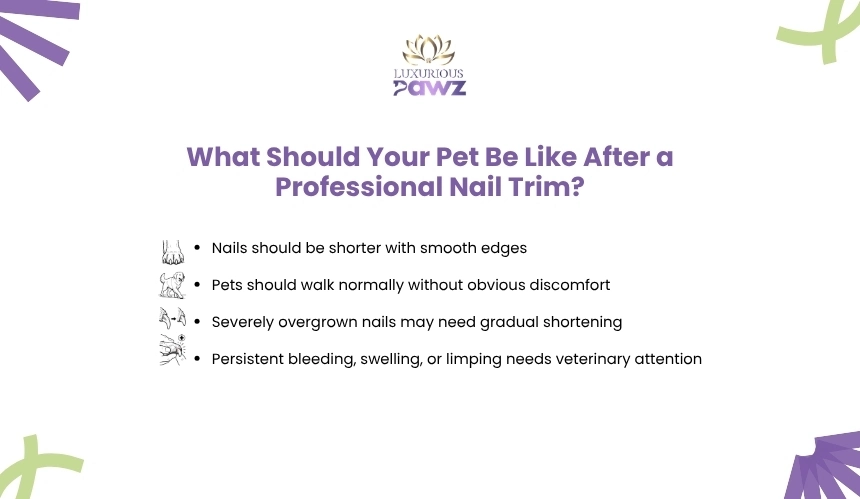
After the appointment, the nails should be shorter, appropriately shaped, and free from unnecessarily sharp edges. The pet should also be able to move normally without obvious post-trim discomfort.
The immediate result can vary depending on how overgrown the nails were. A pet with substantially long nails may not be safely shortened to the desired length in one session because the quick can extend farther into an overgrown nail. Gradual shortening over multiple appointments may therefore be safer than aggressive reduction.
Owners should watch for persistent limping, repeated paw licking, obvious pain, swelling, or continued bleeding. Minor bleeding can occur if the quick is accidentally contacted, but ongoing or significant bleeding warrants veterinary attention.
Broken or severely damaged nails require a different level of care. A damaged nail can expose sensitive tissue and create an infection risk, particularly when the nail bed is involved. Veterinary evaluation is appropriate when the injury is substantial or the pet remains painful.
How Often Should Professional Nail Trims Be Scheduled?
There is no universal appointment interval because nail growth and natural wear depend on the individual pet. Activity level, walking surfaces, age, nail structure, and whether the pet spends most of its time indoors can all change the maintenance cycle.
Dogs that regularly walk on pavement or concrete may naturally wear their nails more than dogs with limited exposure to hard surfaces. VCA notes that many dogs require trimming approximately monthly, while less-active dogs may need attention closer to every three weeks.
For cats, indoor nail maintenance is often more frequent. VCA recommends approximately every two to four weeks for many indoor cats, while outdoor cats may naturally wear their nails through climbing and other activities.
In Altadena, an owner’s schedule should therefore be based on the pet’s actual nail condition rather than a calendar alone. A pet that spends considerable time walking on hard surfaces may show a different growth pattern from one that spends most of its time indoors.
Useful signs that a trim may be due include nails contacting the floor while standing, noticeable clicking on hard flooring, excessive curvature, snagging, or dewclaws becoming visibly elongated.
For pets with a history of fear, scheduling shorter, consistent maintenance sessions can also be more practical than allowing nails to become severely overgrown and then requiring an intensive appointment.
For pet owners throughout Greater Los Angeles, professional grooming can provide consistent nail care without making the process unnecessarily stressful for pets. Luxurious Pawz offers mobile pet grooming with personalized, gentle care, including professional nail trimming for dogs and cats. With service areas including Altadena, Pasadena, Glendale, Burbank, Sunland, Tujunga, Shadow Hills, and surrounding communities, Luxurious Pawz brings grooming care directly to the pet’s home. Explore Luxurious Pawz to learn more or request an appointment.
Frequently Asked Questions
Does a professional nail trim hurt a pet?
A properly performed trim should not be painful because the groomer avoids the quick, which contains nerves and blood vessels. Cutting into the quick can cause pain and bleeding.
How long does a professional pet nail trim take?
The time varies according to the pet’s size, number and condition of nails, handling tolerance, and whether grinding is required. A calm pet with routine nails can generally be completed more efficiently than an anxious pet requiring gradual handling.
Is a nail grinder better than clippers?
Neither method is universally better. Clippers can remove nail length efficiently, while a grinder can provide gradual reduction and smoother edges. The appropriate method depends on nail structure, coat type, pet tolerance, and the groomer’s technique.
What happens if my pet has very long nails?
A professional may shorten them gradually rather than removing excessive length in one appointment. When nails remain overgrown for an extended period, the quick can extend farther toward the tip, limiting how much nail can safely be removed at once.
What if my pet is extremely afraid of nail trims?
The groomer may slow the process, use positive reinforcement, take breaks, or complete fewer nails per session. Severe fear or unsafe resistance may require veterinary or qualified behavioral support rather than forcing the procedure.
How do I know when my pet needs another nail trim?
Check whether the nails touch the ground while standing, click against hard flooring, curve excessively, snag on surfaces, or become visibly overgrown. The appropriate interval depends on the individual pet’s growth and natural nail wear.